
Fast Large Signal Identification (FLSI)
Pre-Release Product
The Fast Large Signal Identification (FLSI) is the result of decades of research in linear and nonlinear system identification and loudspeaker modeling and the next-generation evolution of large signal identification, engineered for engineers who demand maximum insight in minimum time.
FLSI succeeds the established LPM and LSI modules (LSI and LSI3). While these traditional approaches provide valuable small- and large-signal parameters, the FLSI goes significantly further by delivering a more complete and more accurate loudspeaker model in a single, fully automated measurement. This eliminates the need for multiple tools and substantially reduces measurement effort and test complexity. By combining advanced measurement techniques with an enhanced linear and nonlinear loudspeaker model, FLSI reveals the true physical causes of distortion, not just their symptoms. Engineers can instantly identify dominant nonlinearities and focus development where it matters most.
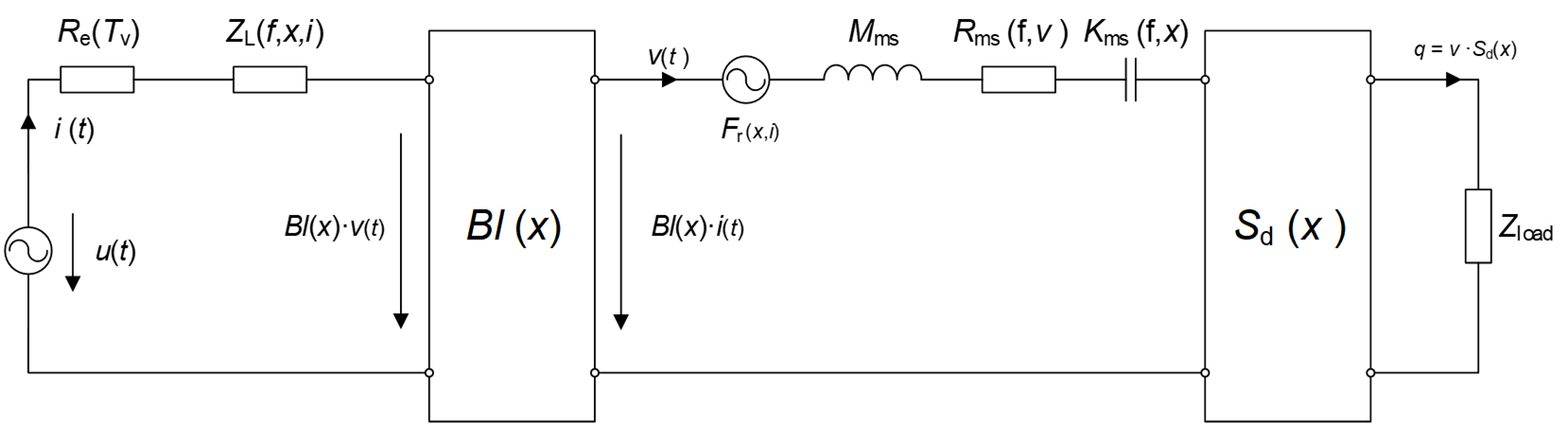
The module also serves as the foundation for Klippel Controlled Sound (KCS), providing the accurate and consistent parameter set required for nonlinear adaptive control. Whether you are optimizing a new driver design, benchmarking multiple units, or pushing the limits of performance, FLSI provides you with the transparency and certainty to reach superior conclusions more rapidly than ever before.
Key Advantages at a Glance
Speed Without Compromise
- Full linear and nonlinear parameter set in as little as 20 seconds
- Fully automated measurement workflow – no manual tuning required
- Maximizes productivity in the lab by reducing measurement time while at the same time increasing accuracy
- Enables rapid iteration and comparison of multiple DUTs in R&D environments
Superior Model Accuracy
- Advanced model including new nonlinearities, such as:
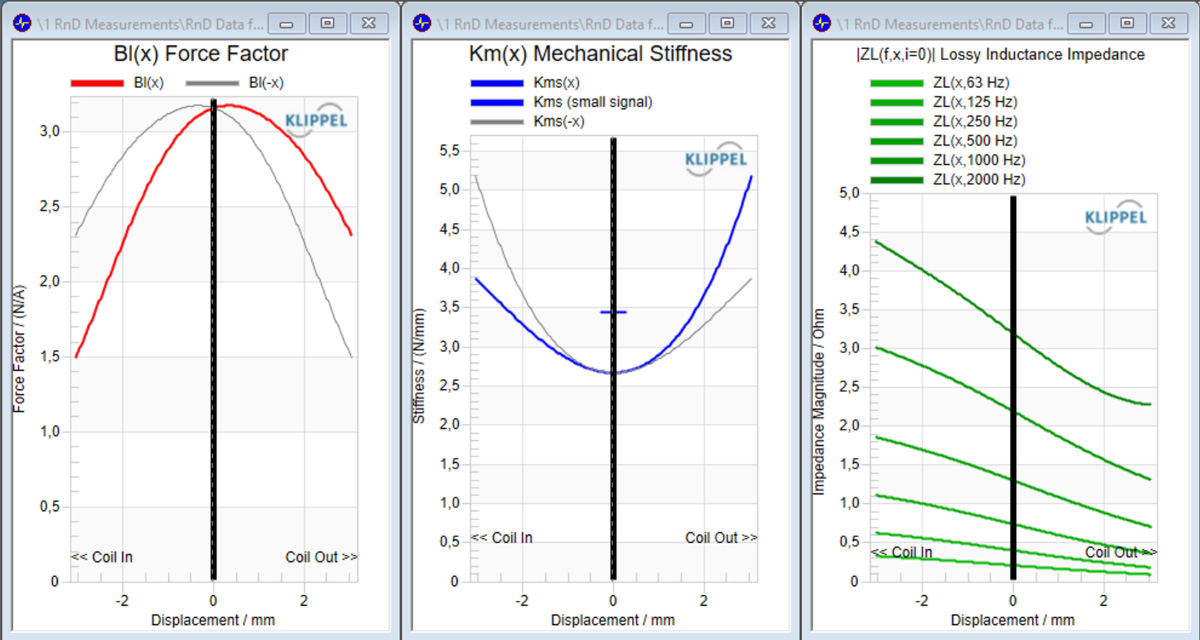
- Frequency-dependent inductance nonlinearity (Read more)
- Nonlinear mechanical creep and hysteresis distortion
- Nonlinear port distortion
- Nonlinear radiation nonlinearity Sd(x)
- Delivers more realistic parameters across the full operating range
- Eliminates simplifications inherent in LSI (e.g., single inductance curve) and LPM (which only supported drivers in free air and sealed speaker systems)
True Root Cause Analysis
- Quantifies the contribution of each nonlinear effect to total distortion
- Visualizes spectral distribution of distortion components
- Automatically detects critical behaviors such as:
- Thermal and mechanical limits
- Time-variant behavior
- Root causes of DC displacement
Intelligent Automation
- Automatic determination of stimulus (level, bandwidth, averages)
- Introducing new protection limits (displacement measured by laser, Rub & Buzz measured by microphone)
- Performs extensive signal checks and provides instant feedback on how to improve the measurement setup
- Reduces user dependency and eliminates setup errors common in LPM and LSI measurement
License Model
- Subscription Model
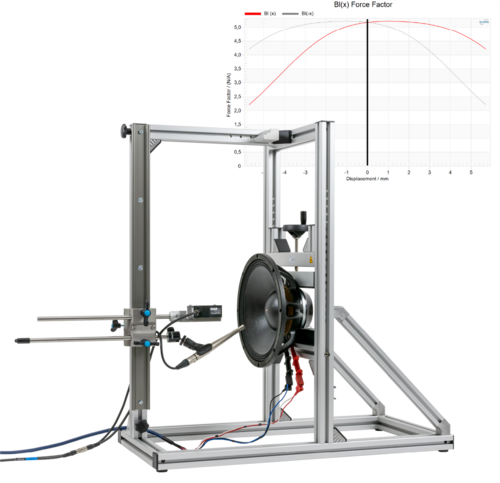
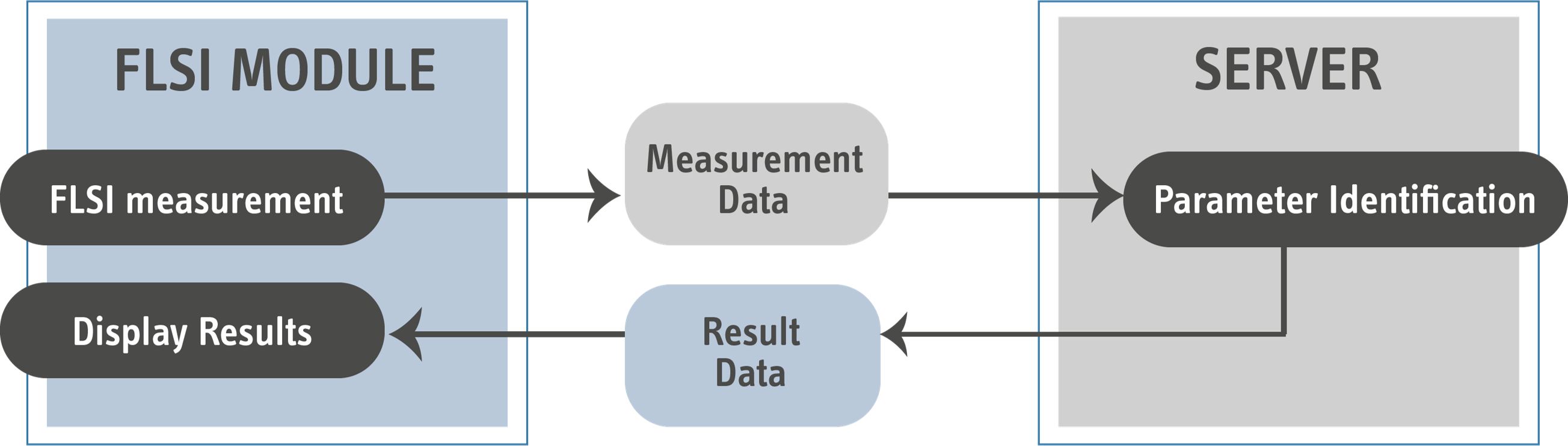
- Parameter identification happens on Klippel Server
- Benefits
- Always use the newest software
- Improve support
Requirements
- Klippel Analyzer 3 (KA3)
- Amplifier (AMP Card or external amplifier)
- PC
Software
- Requires the latest version of dB-Lab 212
Accessories
Internet Access
Parameter identification runs on a KLIPPEL server.
Literature
- Loudspeaker Nonlinearities. Causes, Parameters, Symptoms
- Assessing the Large Signal Performance of Loudspeakers
- Large Signal Performance of Tweeters
- Measurement of Large Signal Parameters
- Loudspeaker Nonlinearities. Causes, Parameters, Symptoms (Know-How Poster)
- Perceptual and Physical Evaluation of Guitar Speakers
- Why and How to Test Voice Coil Position in Production Line
- Measuring the Nonlinear, Lossy, Frequency-dependent Voice Coil Inductance
- Measuring the Nonlinear, Lossy, Frequency-dependent Voice Coil Inductance (slides)
- Validating Nonlinear Transducer Motor Simulation with Measurement
- Validating Nonlinear Transducer Motor Simulation with Measurement (slides)
Patents
- Germany: 10 2007 005 070; USA: US8,078,433B2;
- China: ZL200810092055.4;
- Japan: 5364271;
- India: 162/DEL/2008;
- Germany: 10 2012 020 271 7;
- USA: 10,110,995;
- China: 201380054458.9;
- Korea:10-2015-7012390;
- Taiwan: 102137485;
- India: 844/MUMNP/2015
Module Comparison - What Makes FLSI Better Than LSI
1. Fully Integrated Linear + Nonlinear Measurement
- No need to combine datasets from different modules
(i.e., Bl(0) exchange between LPM and LSI) - Linear and nonlinear parameters identified in one seamless run
Result: Reduced measurement complexity and improved parameter consistency.
2. Deeper Distortion Insight
- Separation and ranking of individual nonlinear distortion sources
- Clear visualization of dominant vs. negligible effects
- Identification of frequency ranges where each nonlinearity is active
Result: Faster design iterations and more targeted engineering decisions.
3. Breakthrough Measurement Speed
Traditional LPM/LSI workflows typically require measurement times of around 10 to 20 minutes to capture small- and large-signal behavior and ensure stable parameter estimation.
FLSI fundamentally redefines this process:
- Typically 10 times faster than LPM/LSI, depending on the setup
- Full linear and nonlinear parameter set in as little as 20 seconds (for small speakers)
- Automated multi-tone stimulus adaptation ensures optimal excitation in a single run
Result: Approximately an order-of-magnitude reduction in measurement time, enabling engineers to evaluate significantly more design variants in the same time.
4. Enhanced Modeling and Parameter Identification
- Advanced nonlinear dynamic inductance model significantly improves the accuracy of all nonlinear parameters
- Comprehensive inductance nonlinearity representation based on impedance magnitude variation, enabling a direct link to amplitude modulation distortion
- Mechanical linear and nonlinear creep and hysteresis effects extracted from electrical data, resulting in more accurate and robust parameter estimation
- Improved parameter fitting across the full bandwidth, ensuring higher overall model accuracy
- Moving mass and Bl(0) identified directly under large-signal conditions, increasing robustness and reducing sensitivity to measurement noise
- Extended set of distortion components, including nonlinear radiation area Sd(x) and port nonlinearities
Result: More stable, repeatable, and accurate parameters than LSI and LPM.
FLSI Standard vs. FLSI Pro
Two configurations, one measurement philosophy. Choose the level of insight that fits your workflow.
Both FLSI Standard and FLSI Pro are built on the same advanced measurement technology. They share the same fast, automated workflow and support the full range of loudspeaker system types. The difference lies in the depth of the analysis and modeling details. You never compromise on the quality of the measurements, only on how far you want to go.
In short:
- FLSI Standard delivers speed, simplicity and a familiar result data set.
- FLSI Pro adds depth, transparency and advanced diagnostic power.
FLSI Standard
FLSI Standard is the ideal choice for users who need robust parameter identification with maximum efficiency.
- Delivers accurate linear and nonlinear parameters using the advanced FLSI measurement approach
- Supports the same transducer and enclosure types as FLSI Pro
- Provides a parameter set comparable to established LSI and LPM modules, with improved model accuracy, greater automation, and faster measurements
- Maintains the key FLSI advantages:
- Fully automated setup
- Minimal measurement time
- Consistent and repeatable results
Typical applications:
A highly efficient solution for characterization, cross-unit comparison, datasheet parameter generation, and selection of reference (golden) DUTs, with a familiar parameter set known from LPM and LSI.
FLSI Pro
FLSI Pro unlocks the full analytical power of the FLSI platform for advanced development and optimization tasks. In addition to all Standard features, FLSI Pro provides:
- Comprehensive distortion analysis
- Separation and visualization of individual nonlinear distortion components
- Identification of dominant physical root causes
- Thermal parameter identification
- Short-term thermal behavior and power handling estimation
- Extended results
- More detailed representation of nonlinear effects, such as frequency-dependent inductance nonlinearity
- Additional protection limits
- Measures impulsive distortion (Rub & Buzz)
Typical applications:
The solution for engineers who need deep physical insight, detailed analysis, and a complete set of parameters.
FLSI succeeds the established LPM and LSI modules. The following feature comparison compares our small- and large signal identification solutions and gives a general feature overview.
Feature Comparison
| Feature | LPM | LSI3 | FLSI Standard | FLSI Pro |
|---|---|---|---|---|
| Measurement speed | Depends on DUT (~15 sec – 3 min) | Slow (~10 min) | Fast (<1 min possible) | Fast (<1 min possible) |
| Measurement consistency and accuracy | High | High | Unmatched | Unmatched |
| Supported speaker/enclosure types | Free air, sealed, (tweeter) | Free air, sealed, vented, (tweeter) | Free air, sealed, vented, passive radiator, sidefire, tweeter, moving magnet | Free air, sealed, vented, passive radiator, sidefire, tweeter, moving magnet |
| Parameter set | Small signal parameters | Large signal parameters | Small- and large-signal parameters | Small- and large-signal parameters |
| Bl(x) nonlinearity chart | — | ✓ | ✓ | ✓ |
| Km(x) nonlinearity chart | — | ✓ | ✓ | ✓ |
| Inductance (x) nonlinearity chart | — | One effective L(x) curve, depending on stimulus | Impedance ZL(x,f=8.5*fs) | Frequency-dependent nonlinear ZL(x,f) curves |
| Flux modulation chart | — | ✓ (L(i)) | ✓ (λ(i)) | ✓ (λ(i)) |
| Rms(v) nonlinearity | — | Only LSI3 Microspeaker | ✓ | ✓ |
| Bl(x) and Kms(x) symmetry ranges | — | ✓ | ✓ | ✓ |
| Linear and nonlinear creep model | Limited linear creep modeling | — | ✓ | ✓ |
| Voltage sensitivity vs. frequency in large- and small-signal domain | Small-signal only | — | ✓ | ✓ |
| Nonlinear distortion component of internal mechanical damping | — | — | — | ✓ |
| Nonlinear distortion component Sd(x) | — | — | — | ✓ |
| Nonlinear distortion component of ports in vented systems | — | — | — | ✓ |
| Distortion component analysis (single values) | — | Limited | — | ✓ |
| Distortion component spectra | — | — | — | ✓ |
| Thermal parameter identification | — | — | — | ✓ |
| Rub & Buzz protection limit | — | — | — | ✓ |
| Displacement protection limit | — | — | ✓ | ✓ |
| Detailed signal checks (i.e., clipping detection) | — | — | ✓ | ✓ |
| Error messages with user guidance | Limited | Limited | ✓ | ✓ |
| Transparency of error metrics | High | Limited | High | High |
| Under active development | — | — | ✓ | ✓ |
| Measurement of initial KCS data set | — | — | ✓ | ✓ |
Comprehensive Feature Set
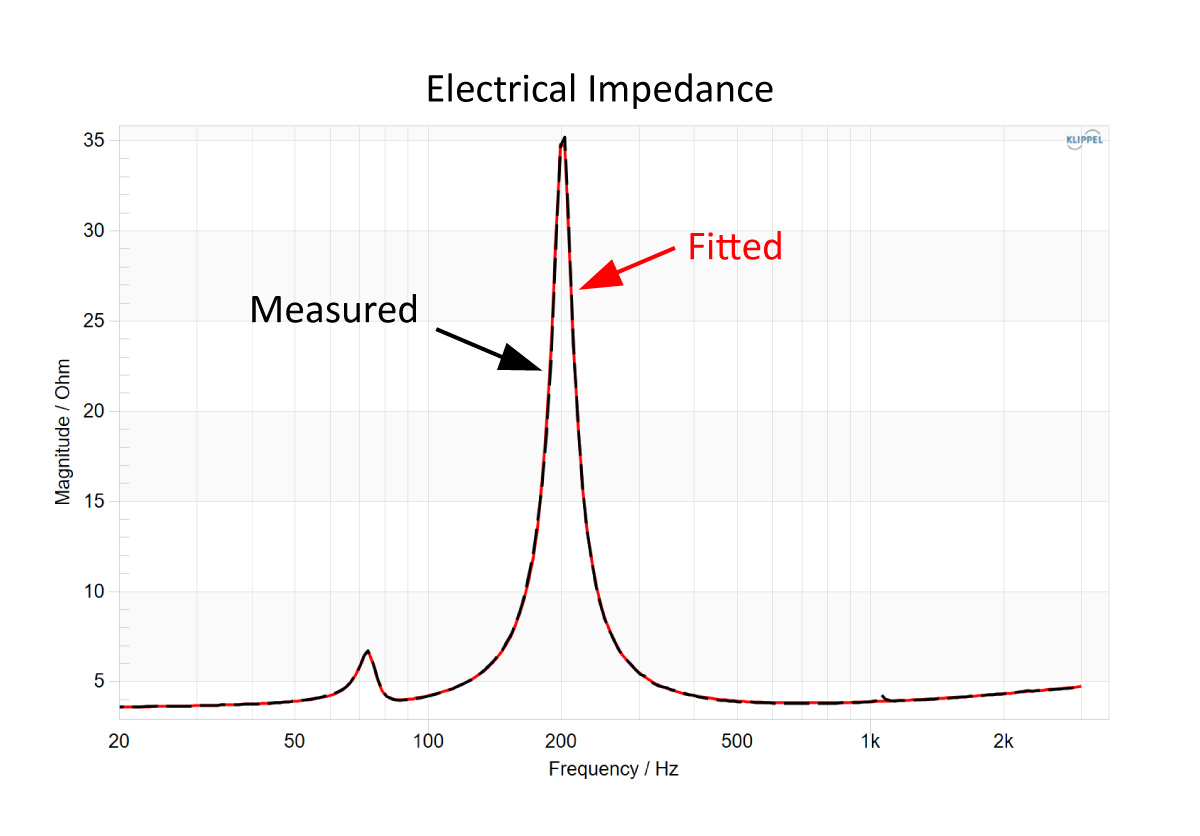
Full-System Flexibility
- Supports measurements in:
- Free air, infinite baffle, sealed, vented, and passive radiator systems
- Applicable to a wide range of transducers:
- Woofers, tweeters, microspeakers, exciters
- Enables testing under realistic operating conditions, including enclosure interaction
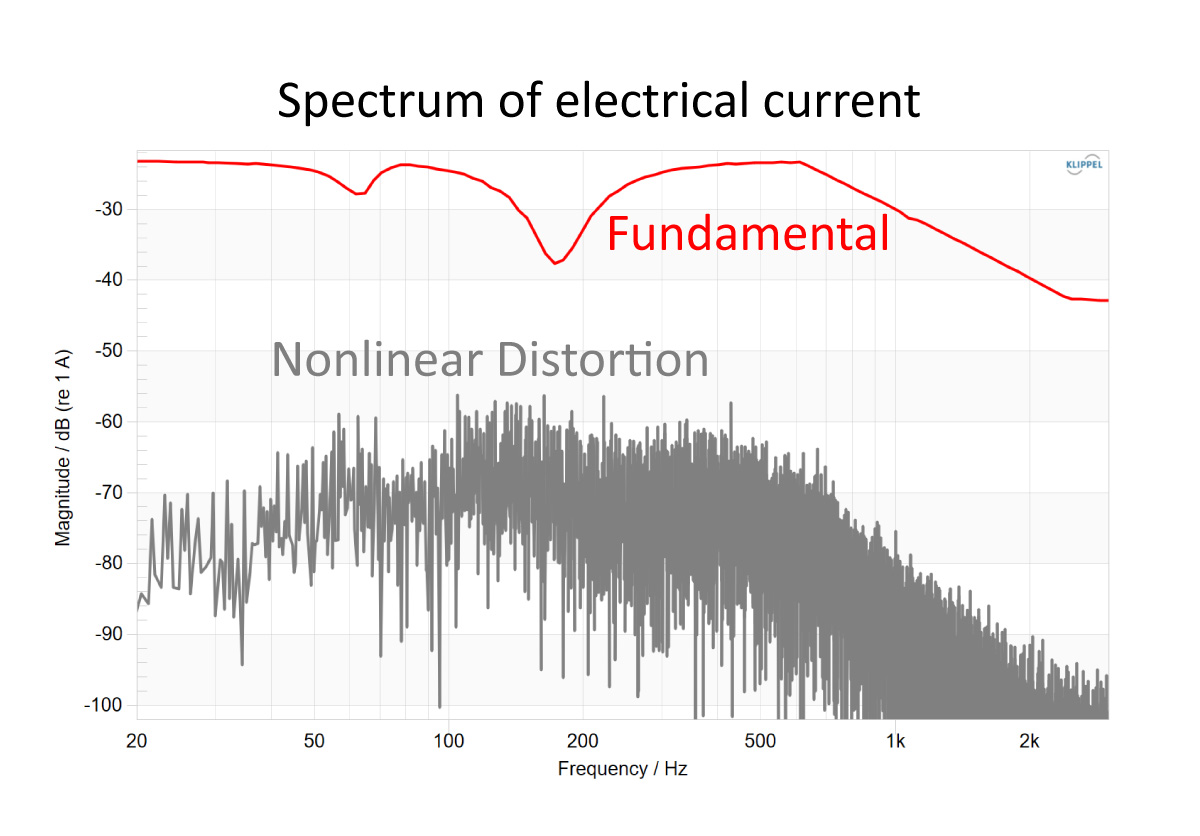
Fully Dynamic Measurement Approach
- Identification based on a continuous, dynamic multi-tone excitation signal rather than discrete operating points
- Captures transducer behavior across the entire operating range in a single measurement
- Reflects real-world signal conditions, including level-dependent and dynamic nonlinear effects
- Avoids the limitations of point-by-point methods, which may miss interactions between nonlinearities or dynamic phenomena (Read more)
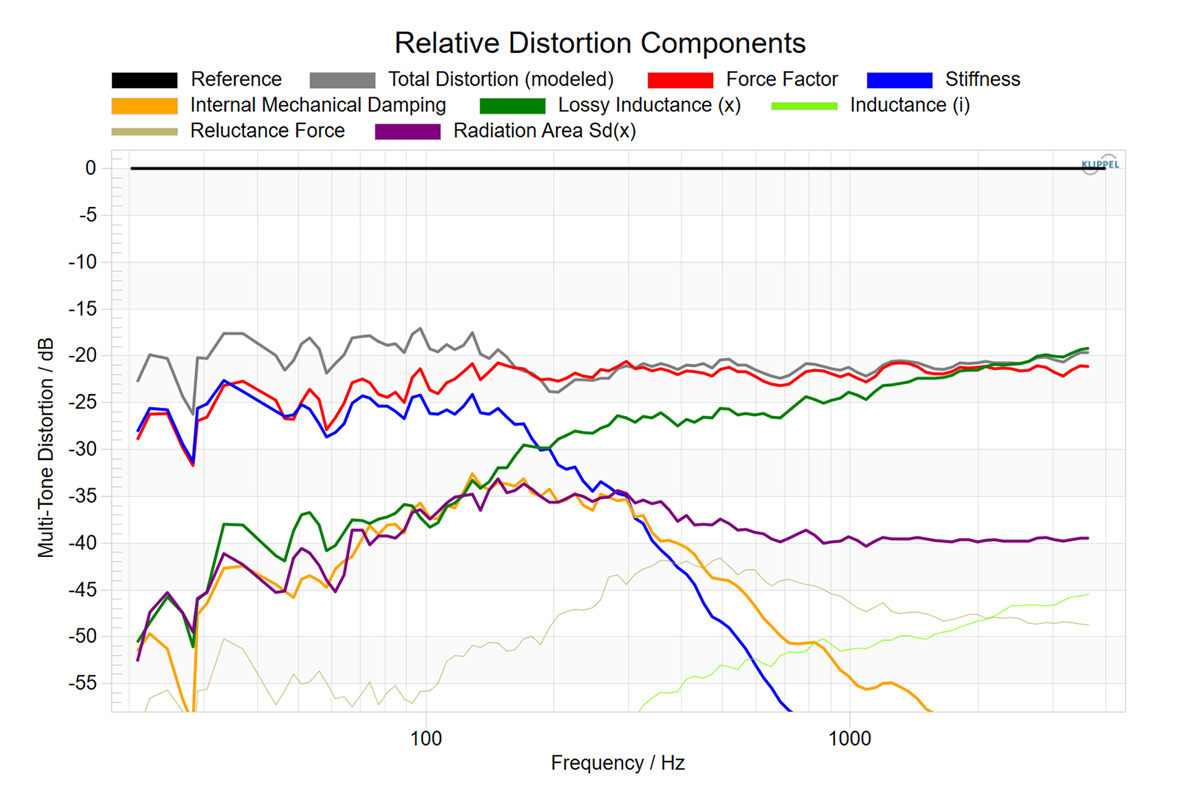
Distortion Analysis (FLSI Pro)
- Decomposition of total distortion into individual components
- Clear identification of dominant nonlinearities
- Spectral analysis of each distortion mechanism
- Enables targeted design improvements by linking measured behavior to physical causes
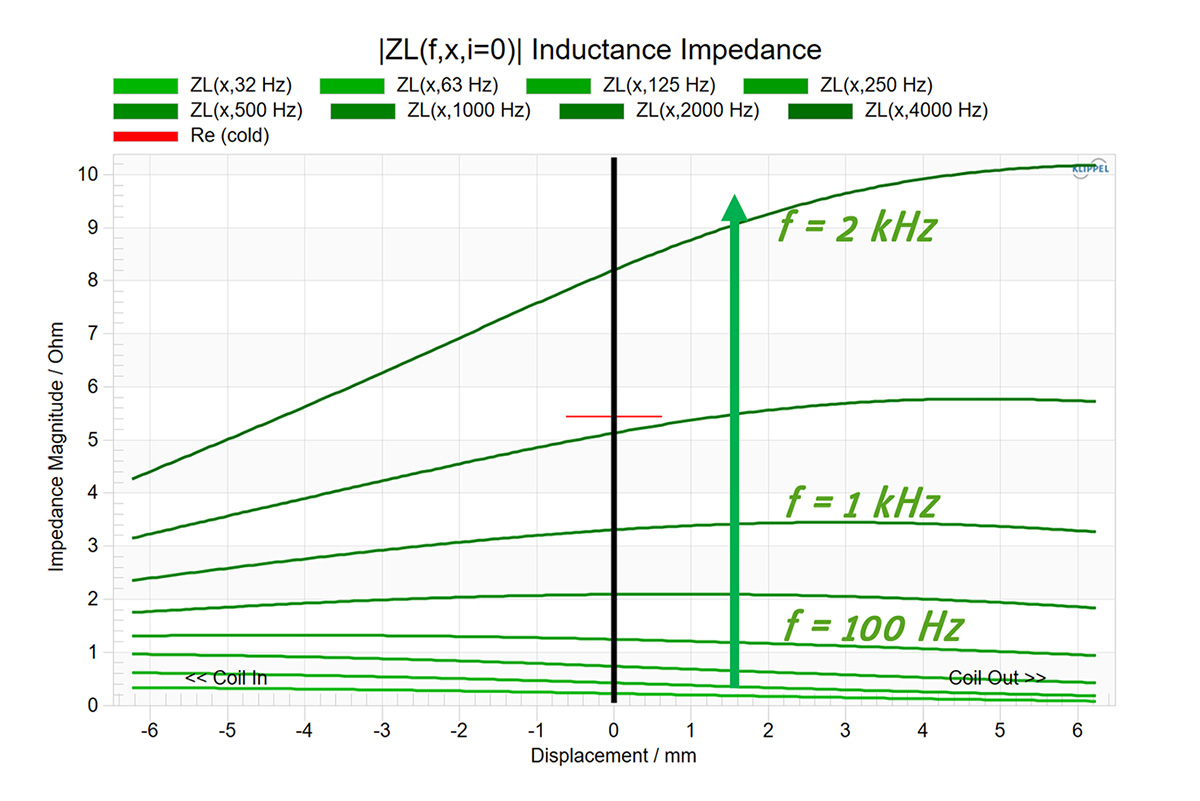
New Nonlinear Dynamic Inductance Model (FLSI Pro)
- Frequency-dependent inductance nonlinearity
- Representation based on impedance magnitude, directly linked to amplitude modulation distortion
- Allows comparison with FEA (Read more)
- Allows for investigating the impact of shorting material and tuning it for the target frequency band
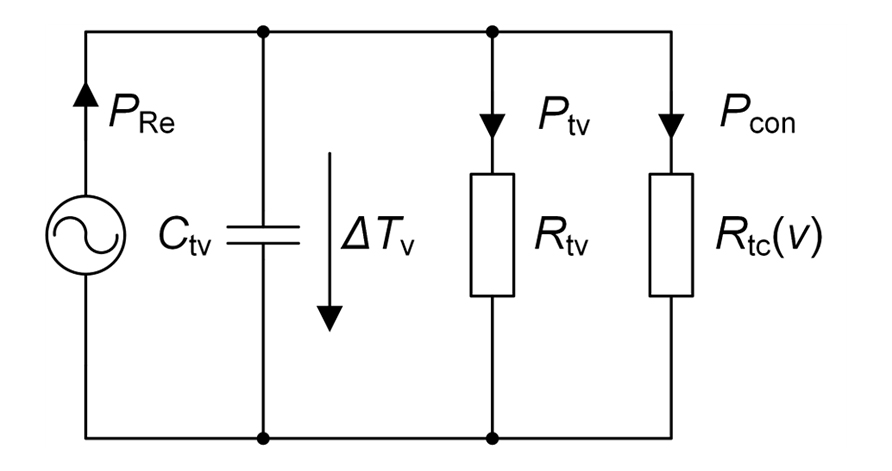
Thermal Characterization (FLSI Pro)
- Fast identification of short-term thermal parameters
- Includes effects such as power compression and convection cooling
- Enables estimation of power handling under realistic signal conditions
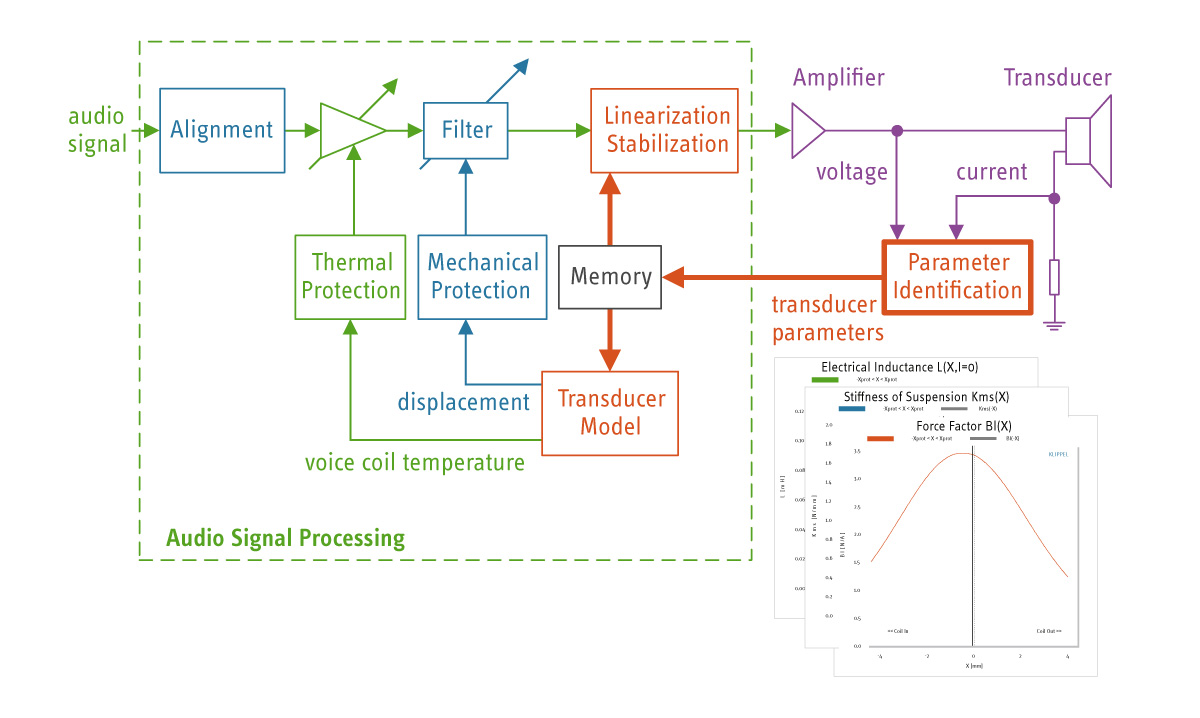
KCS Integration
- Generates initial parameters for Klippel Controlled Sound (KCS)
- Seamless transition from measurement to speaker design optimization and KCS evaluation and implementation
- Accelerates development of high-performance, actively controlled systems
